

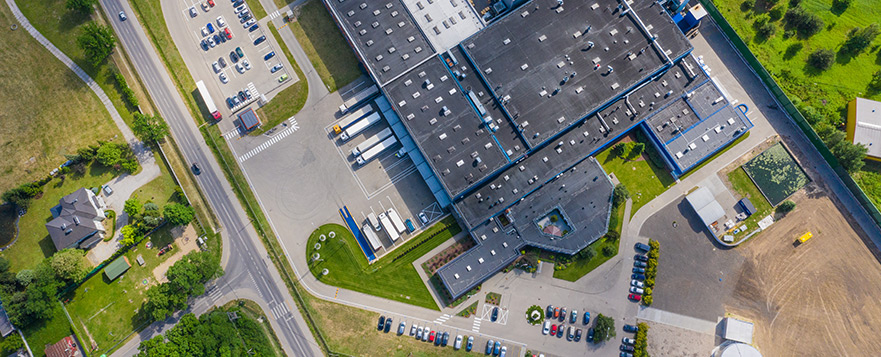
Ground Improvement for Industrial facilities
Ground improvement solutions to enhance soil performance and control settlement
Ground improvement techniques play a critical role in enabling the safe and cost-efficient construction of industrial facilities on challenging soil conditions. From energy plants to logistics platforms and heavy manufacturing sites, VSL delivers tailored ground treatment solutions that optimize soil performance and reduce the need for over-designed foundations. These solutions help mitigate settlement, increase bearing capacity, and ensure long-term operational reliability.
The Role of Ground Improvement in Industrial Construction
Industrial facilities often involve heavy static and dynamic loads from equipment, storage, and structural elements. Ground improvement enhances the load-bearing capacity of soft or loose soils, ensuring long-term performance under demanding operational conditions.
High loads, expansive footprints, and variable subsurface profiles increase the risk of uneven settlement. Ground improvement techniques are applied to achieve uniform ground response and minimize distortion of sensitive structures or equipment.
Sites with compressible clays, uncontrolled fill, or high water tables may be unsuitable for direct construction. Ground improvement transforms such sites into viable platforms for industrial development, reducing the need for costly deep foundations.
VSL’s Ground Improvement services for Industrial Facilities
VSL delivers tailored ground improvement solutions for industrial facilities, combining geotechnical engineering, proven treatment methods, and rigorous quality control to ensure reliable foundation performance.
Engineering and soil behavior analysis
• Ground treatment feasibility studies and improvement design
• Performance-based design aligned with facility requirements
Ground improvement methods
• Controlled Modulus Columns (CMC): Rigid inclusions installed with minimal vibration, suitable for sensitive equipment foundations.
• Dynamic Compaction: Used on granular fills to increase density and reduce settlement risks.
• Vertical Drains with Preloading: Applied to accelerate settlement in cohesive soils prior to construction.
• Jet Grouting: Creates high-strength soilcrete columns where precise treatment control is required.
Execution and monitoring
• In-situ quality control through cone penetration tests, pressuremeter testing, and settlement monitoring
• Documentation and certification of performance criteria
Why Choose VSL for Ground improvement?
Proven expertise in industrial environments
VSL has decades of experience delivering geotechnical solutions for complex industrial sites, including refineries, energy facilities, and process plants.Integrated ground-to-structure capabilities
By combining geotechnical improvement with foundation engineering, post-tensioning, and slab-on-grade systems, VSL delivers end-to-end solutions with technical and commercial coherence.Custom method selection and innovation
VSL selects and adapts the most appropriate ground improvement methods based on site constraints, construction logistics, and long-term serviceability targets.
FAQ about Ground Improvement
Whenever poor soil conditions, high loading demands, or strict settlement tolerances are present, ground improvement can enhance site suitability and reduce foundation costs.
The decision is based on soil conditions, loading requirements, construction sequence, and environmental considerations. VSL performs site-specific evaluations to guide method selection.
Yes. VSL routinely combines ground treatment with foundation design, post-tensioning, and slab-on-grade construction to deliver holistic building solutions.