

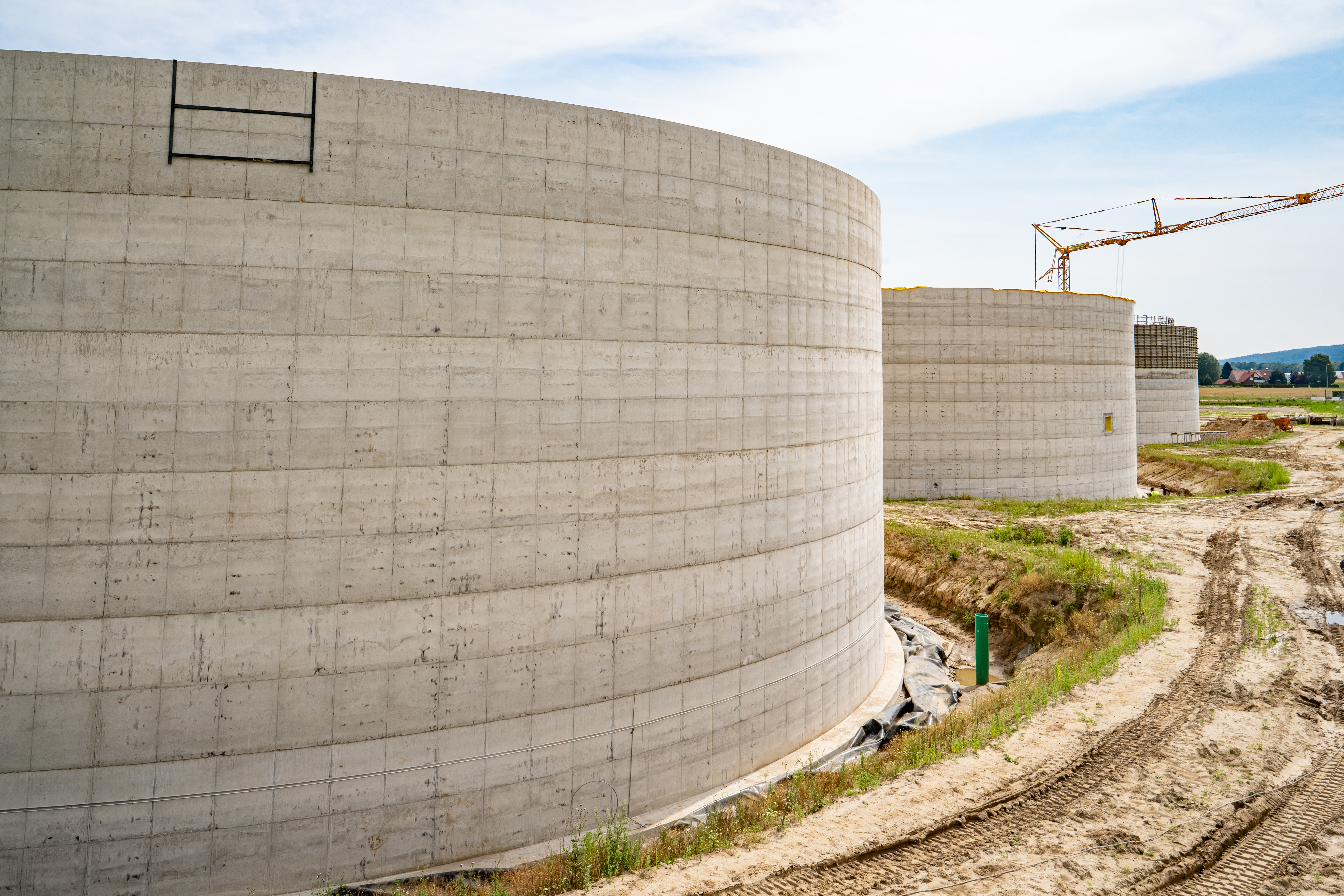
Post-Tensioning for Storage Tanks & Silos
Concrete reinforcement for safety, watertightness and durability
Post-tensioning is an active structural reinforcement method used in storage tanks and silos to improve safety, durability and watertightness of critical containment structures. In large containment tanks, such as those for Liquid Natural Gas (LNG), post-tensioned concrete ensures resistance to hydraulic pressure and limits cracking under load, providing essential protection even if the primary steel tank containment is compromised.
Why post-tensioning for storage tanks & silos
Post-tensioning compresses the concrete. This supports resistance to leakage and hydraulic pressure.
It improves the concrete’s ability to withstand high internal loads and environmental forces.
Compression limits cracks and slows degradation over time.
Post-tensioning helps tailor reinforcement to project needs and site constraints.
Optimized reinforcement can reduce concrete volume and support construction timelines.
VSL’s post-tensioning services
VSL provides a complete post-tensioning service for storage tank and silo containment applications, combining design support, supply of tendons and full installation execution.
Assessment of containment design requirements
Post-tensioning design coordination
Supply of strand tendons and anchorage components
Installation support and supervision
Optional monitoring services for performance verification
Why choose VSL for post-tensioning
Post-tensioning expertise
VSL’s systems are mature, reliable and built to meet high safety and durability requirements.Tailored solutions
Each post-tensioning layout is adapted to the tank’s design, loads and performance needs.Comprehensive delivery
Design, materials and installation support are coordinated for performance and schedule.Integration capability
Post-tensioning can be combined with ground improvement, cut-off walls or other foundation systems for robust overall solutions.
FAQ about post-tensioning in tanks and silos
It is a method to apply compressive forces in concrete to limit cracks and improve structural performance.
To ensure watertightness and resistance to hydraulic pressure even if the primary containment fails.
Yes. VSL can recommend and provide monitoring services to track performance over time.