

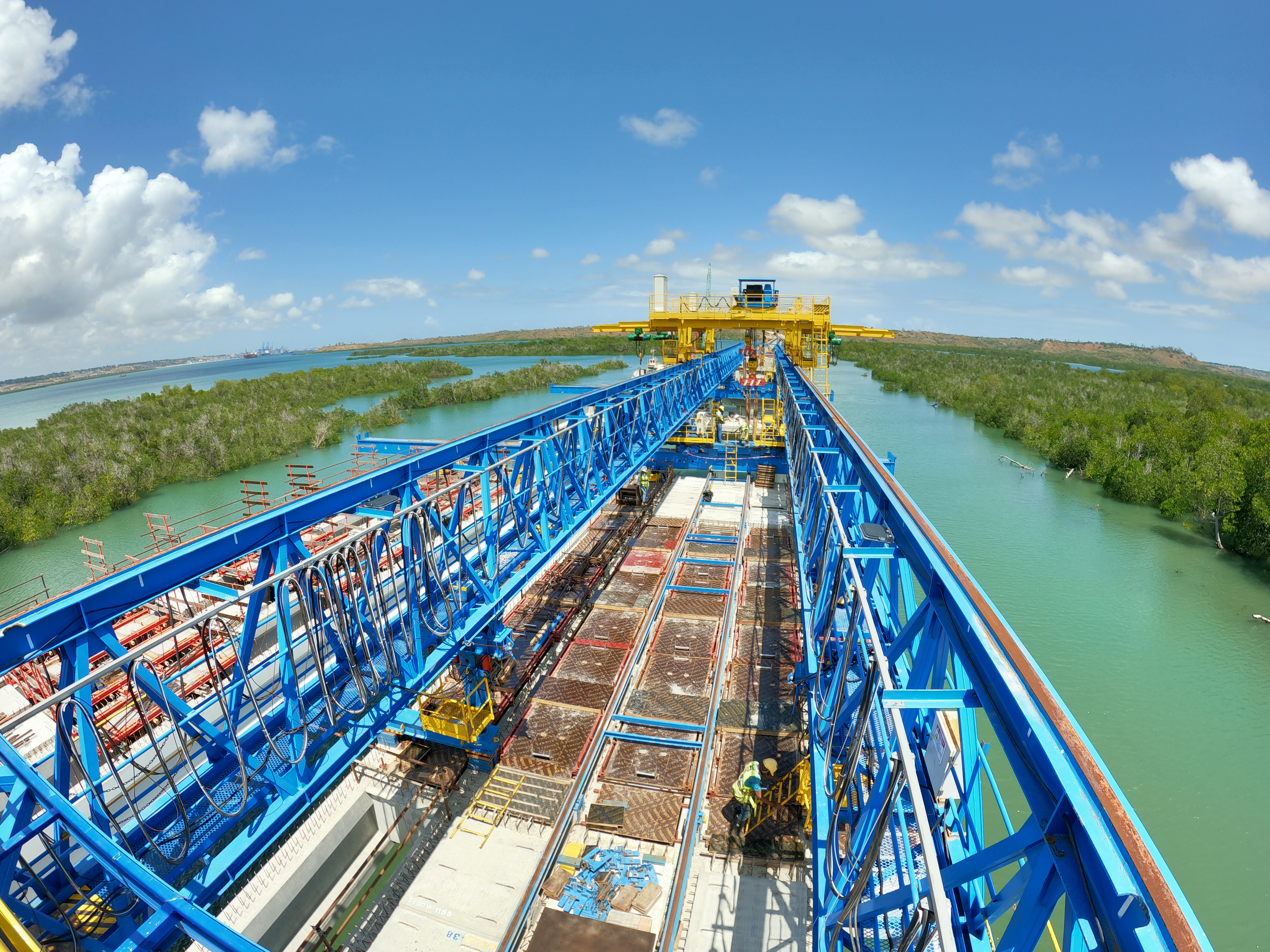
Bridge deck construction
Deck erection for bridges and viaducts
As a specialist contractor, VSL delivers bridge decks using the most appropriate construction method: span-by-span, balanced cantilever, incremental launching, precast or cast in-situ. Each project relies on rigorous engineering, including temporary works design, detailed planning and controlled execution. VSL provides end-to-end services, from design support and construction engineering to temporary works, formwork systems, precasting, erection works, and post-tensioning, fully tailored to each project’s specific requirements.
Our deck construction methods
Depending on span length and the bridge length, this method is ideal for precast segmental or full span construction erected sequentially with launching gantries, overhead or underslung or on temporary supports, more seldom with twin cranes for full spans. The spans can be either simply supported or continuous over several piers and on bearings or monolithic with the piers, taking advantages of a frame action allowing a better use of the construction materials. Pre or post-tensioning allows the structures to be assembled efficiently and also provides substantial reduction of concrete and rebar materials. Spans are generally between 30 and 50 meters long, sometimes up to 60meters. Beyond this, cantilever construction (see below) becomes more economical, except for very long spans (greater than say 800 meters) where suspension bridges then take over.
Span by span can also be made of longitudinal beams supporting the deck with spans between say 25 and 60 meters.
Applicable for long spans (generally greater than 60m) or shorter spans with tight curves. Beyond say 80meters, the deck might then be supported also with extradosed tendons or stay cable. Segments, either precast or cast-in-situ, are built in balance outwards from piers using form-traveler systems for in-situ structures or cranes or lifting frames of launching gantries for precast segmental construction. Cantilever structures are then connected at mid span with an in-situ stitch and post-tensioning tendons generally ensure continuity of the deck between piers. Decks are generally continuous over several spans and can either be resting on bearings or be rigidly connected to the piers, allowing a frame action. In special cases, cantilever may be assembled parallel to a road or a rail track and then rotated above that path in final position.
The deck, either concrete or steel or a combination of both, is prefabricated in subsequent sections connected together at the abutment and then launched over the piers using a front nose, lateral guides, temporary sliding bearings and an heavy lifting system providing the motion to the structure. For concrete structures, the post-tensioning is arranged to allow the structure to take respectively positive and negative moments at each section.
This method is generally applicable for structures with constant geometry in plan and in elevation. It provides the least disruption to the traffic below. Spans are generally between 30 and 60 meters. In special cases, spans can be longer, but might require intermediate temporary towers or permanent or temporary stays for launching.
Heavy lifting is a very efficient construction method able to mobilize hundreds, sometimes, thousands of tons of capacity.
Individual precast spans or deck sections are lifted into position using strand jacks mounted on lifting frames or gantries. The method is particularly applicable for long droop-in spans or full spans between piers that can be lifted in one short operation mitigating disruption to the traffic below.
Each method can be combined with customized formwork, prefabrication setups, and launching equipment – including our modular systems and heavy-lifting technologies.
Our Design & Build capabilities
VSL provides fully integrated Design & Build Services for bridge deck construction, combining engineering expertise and proprietary equipment.
Our scope includes:
Design, supply, assembly, and commissioning of major equipment
Engineering methods and sequencing
Temporary works & precasting expertise
Deck erection
Why choose VSL for deck construction?
360° integrated delivery
We offer full-service engineering, temporary works design, manufacturing, and on-site execution.Specialized equipment
Proprietary form-traveler systems, launching gantries, lifting frames, and modular formwork are engineered for safety, productivity, and adaptability.Proven global track record
Over 60 years, VSL has completed iconic bridge deck projects worldwide, from span erection to post-tensioning and monitoring.Efficiency and sustainability
Our methods minimize on-site time, reduce traffic impact, and support low-carbon outcomes through off-site prefabrication and fast-track erection.
FAQ about BRIDGE DECK ERECTION
It depends on span length, site constraints, prefabrication option, and schedule.
VSL engineering tailors the solution using our 360° technical framework.
Yes. Solutions like launching or lifting outside traffic and modular off-site prefabrication enable minimal on-site closures.
Through detailed temporary works design, load monitoring, and safety procedures embedded in our project engineering process.