

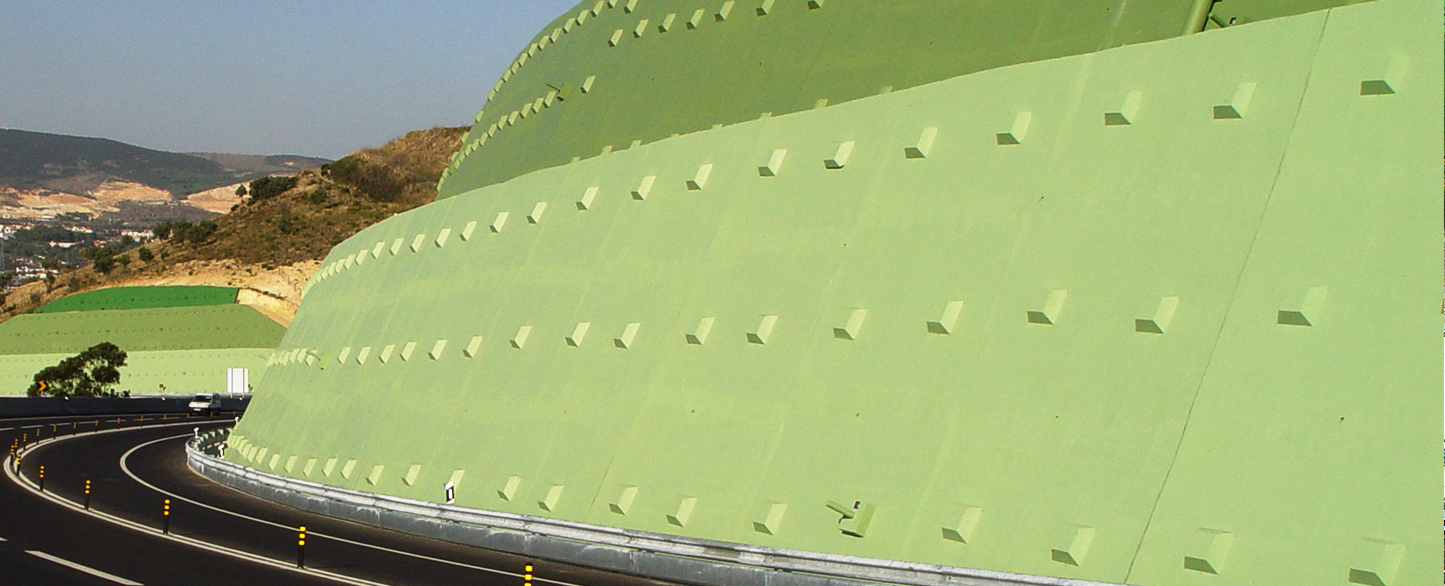
Ground Anchors for Roads and Railways
Active and passive ground anchors for roads and railways
Ground anchors are essential in stabilizing retaining structures, supporting slopes, and controlling ground movements in transport infrastructure. Used extensively in the construction and rehabilitation of roads, railways, and tunnels, VSL’s ground anchor systems deliver reliable load transfer and long-term performance in demanding geotechnical conditions. VSL offers fully engineered solutions, including design, supply, testing, and installation of post-tensioned and passive ground anchors.
The role of ground anchors for roads and railways
Ground anchors prevent overturning or sliding of retaining walls, especially in cuttings or steep embankments.
Used for both short-term construction phases and long-term stabilization of slopes or structures.
Anchors can resist tensile forces exceeding hundreds of kilonewtons, depending on soil conditions and anchor design.
Anchoring systems require limited excavation and allow construction in constrained or sensitive areas.
VSL’s ground anchor services for your road and railway projects
VSL delivers engineered ground anchor solutions that combine high performance, durability, and rigorous quality control to ensure reliable support in demanding infrastructure projects.
Anchor types and applications
• Passive anchors: Activated by ground movement or structural displacement; used in situations where preloading is not feasible.
• Bar anchors: Used in shorter lengths or lower capacity applications.
• Temporary and permanent anchors: Designed with corrosion protection levels based on service life and site exposure.
Design and load testing
• Anchor length, free length, and bonded length optimization
• Corrosion protection and durability requirements
• Load transfer efficiency and tendon selection
• Acceptance and proof testing (e.g., creep, failure, or cyclic tests)
Installation and quality control
Why choose VSL for ground anchors?
Integrated geotechnical expertise
VSL combines engineering design, tendon technology, and site execution for seamless delivery.Certified systems
VSL’s ground anchor solutions comply with major international specifications and national approvals.Advanced equipment
VSL uses specialized rigs and jacking systems to ensure accuracy and safety in constrained access areas.Extensive references
Deployed across slope stabilization, retaining structures, and tunnel construction worldwide.
FAQ about Ground Anchors
Anchor capacities typically range from [placeholder range], depending on the number and type of strands or bars, ground conditions, and project requirements.
VSL designs permanent anchors with corrosion protection for service lives of [placeholder range] years, based on national design codes and environmental exposure.
Temporary anchors can be designed for full or partial removal depending on site conditions and regulatory requirements.