


Decarbonization in motion
« Climate change is the defining issue of our time - and we are at a defining moment. »António Guterres
Our starting point
In line with Bouygues Construction’s objectives, VSL is strongly motivated and committed to reducing its greenhouse gas emissions by 2030. These targets have been validated by the Science Based Targets initiative (SBTi). This certification attests that the company’s commitments are in line with current scientific data on climate and with the Paris Agreements.
Here are our objectives in detail!
We have laid out a strategy to achieve our goal. Here is the plan!
Reducing our own carbon footprint
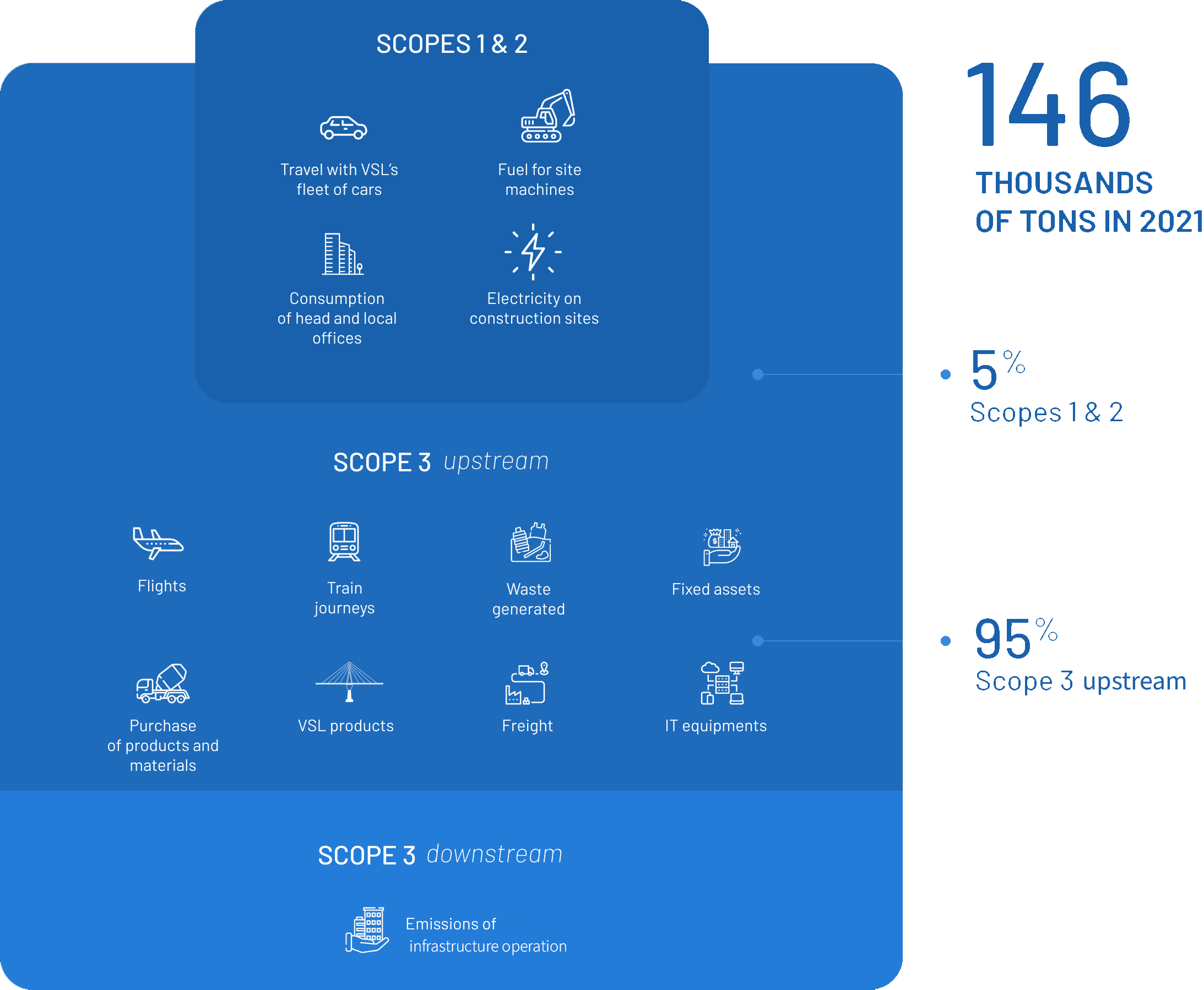
Every year since 2019, VSL has calculated its carbon footprint on the basis of scopes 1, 2 and 3 upstream, and has refined its scorecar at the end of 2020 with more complete and accurate data. Below are our findings:

Limiting our indirect emissions up stream
The main finding of our 2021 carbon footprint calculation is that 95% of our emissions come from Scope 3, meaning indirect emissions upstream. These emissions are mainly linked to strand and bar purchases. We have started to concentrate our efforts on this burning issue!

Our plan
- Evaluate the carbon footprint of our products (Environmental Product Declaration). Depending on the EPDs, VSL will adjust its strategy for the technologies and supply chain.
- Our purchasing department assesses the global warming potential of our main suppliers’ steel strands, using EPDs. To support transparency, VSL offers its Strand Climate Score—an open-source tool that rates and compares the carbon impact of steel strands—free to the entire industry.
- View Climate Score.
Acting at the local level
Reducing the carbon footprint of the structures we build or repair
Know better, act better
MAKING AN INFORMED DECISION FROM THE GET-GO
Expanding our low-carbon economy portfolio
Reducing one’s carbon footprint doesn’t just stop after the project is complete. Our aspiration is that the structures we build and repair continue to contribute to a low-carbon way of living.
This is why we have set up the aim to generate 50% of our business in sectors in the low-carbon economy by 2027, namely:
- The low-carbon transport infrastructure, which includes rail or other electric transport systems, as well as soft transport modes.
- The construction of assets facilitating the generation, storage or transmission of net-carbon-zero energy, mainly nuclear and wind energies.
- The repair and preservation of structures, that generate less carbon than a new built.
Below are our most recent projects related to the low-carbon economy:
Learn more about our climate commitment
Discover how VSL measures, monitors, and transparently shares its environmental impact. These initiatives demonstrate our ongoing commitment to reducing carbon emissions and building a more sustainable future.